
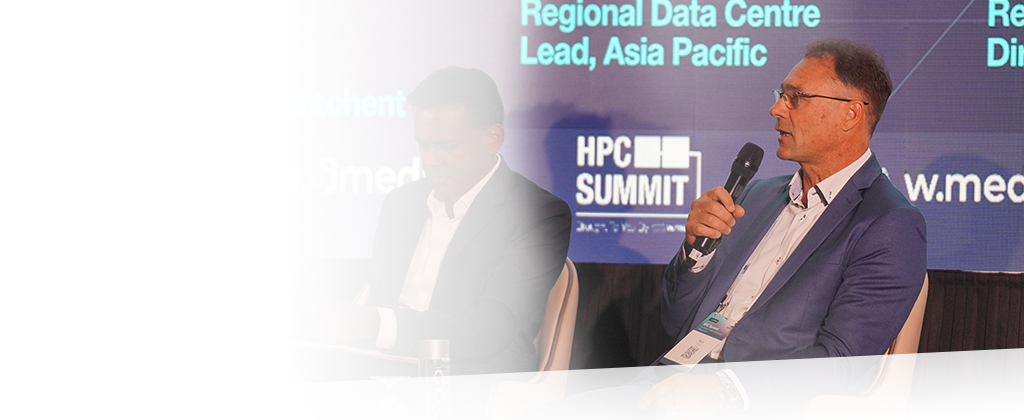
Rack densities that sat at 12 to 15 kW a few years ago are now regularly exceeding 100 kW. NVIDIA's Vera Rubin platform is expected to land at just over 230 kW per rack, with the industry already discussing 600 kW deployments and a mythical 1 MW rack. That trajectory was the subject of HPC Summit Southeast Asia 2026's panel in Singapore under the title "Cooling the AI Factory: Scaling Liquid and Immersion Cooling for High-Density AI Infrastructure." As rack density and power climb past what conventional air-cooled data centers were built for, two questions framed the session: what breaks first, and whether today's data center can keep up with the transition pace at all. The panel brought four different roles in the cooling supply chain to answer them: Mark Roberts (Castrol, fluids and monitoring), Professor PS Lee (NUS, liquid cooling research), Thiru Prakassh (OVHcloud, data center operations), and Mark Langford, STULZ's Regional Technical Director for APAC.
The scale of the challenge was set early. At Cannes, the week before the summit, Microsoft and Meta revealed they'll each deploy as much IT compute this year as they installed across the entire previous decade. That pace changes what's expected of a vendor, since NVIDIA and other suppliers keep resetting the parameters the industry has designed around for years, whether that's power thresholds, coolant composition, or liquid loop specifications.
Equipment vendors have to track those shifts in real time while running factories at volumes large enough to meet AI-scale deployment schedules. It's a version of the analogy Roberts opened the session with — the industry is designing the plane while flying it. Mark Langford emphasised that staying ahead of a moving target and manufacturing at that scale are two distinct jobs, and neither can lag behind the other. Delay on one and a vendor risks shipping equipment that's already behind the rack densities a customer demands by the time it reaches site.
Professor Lee added a design dimension to the same pressure: most facilities can't switch from air to liquid cooling overnight, especially brownfield sites with ongoing operations and existing CapEx sunk into air-based infrastructure. That's why the industry increasingly needs transition solutions like air-assisted liquid cooling, which absorb rising densities without forcing a full rebuild. These hybrid approaches let operators phase liquid cooling in, protecting the CapEx already committed to air-cooled systems.
That transition doesn't stop at the cooling loop. The physical shape of an AI-ready facility is changing. As Mark mentioned, traditional white space, built for large halls of low- to medium-density racks, is downsizing. It's most visible in retrofits, where power capacity limits are already too tight to add more racks into that freed up floor space. Gray space is growing instead: CDUs, pumps and pipework now take up more of the footprint and now becoming more central to the design.
Mark Roberts pointed to a recent example: a facility built for roughly 20 kW racks, later retrofitted with liquid cooling, that left the operator unable to recover its original investment. The core problem, he explained, is that heat capture has to move down to the node and rack level once densities pass roughly 100 to 200 kW, because a standard chiller built to handle 1 percent heat loss from a 15 kW rack can't do the same job at ten or twenty times that load. GPUs and CPUs can be cooled directly at the cold plate, but memory, cards, and power supplies still give off heat to the air, which means facilities need heat management at the node, rack, and multi-rack level all at once. That coordination gets harder still with racks of different heights and widths, which push careful planning aisle by aisle rather than one standard layout.
That kind of risk raises an obvious question: what fails first as an AI environment scales? And perhaps there's no single answer to this. For Prakassh, it depends on where an operator is starting from. Those who haven't yet installed direct-to-chip cooling hit the cooling limit first, because conventional data centers simply can't handle today's AI heat loads. Power tends to depend more on location: in Ireland, he noted, data centers already use around 22 percent of the country's electricity, and grid capacity is running out. That's a different problem from what most Southeast Asian markets face today. Operations, in his view, is the easier fix compared to the talent gap.
Talent, in fact, may be the deeper constraint of the three, according to Mark Langford. Power, land, and water use are hard limits in some markets, but they can be solved with money and planning. Building skills in liquid cooling can't be solved that way. Training technicians to work safely around pressurized coolant loops and live IT load takes time. Attracting new engineers into a field, which many still see as unfamiliar, adds another layer to the problem. None of it fits the industry's current deployment pace. That’s why he encourages bringing facility and IT teams together early, before those gaps turn into delays.
Professor Lee observes the question from a more holistic perspective, warning against treating power, cooling, and compute as separate problems to begin with. Take 45°C liquid cooling as an example. Running electronics at higher inlet temperatures cuts cooling overhead and lowers PUE on paper. But it can also cost more power at the chip level, require fluid treatment such as PG25 to control biofouling, and weaken the fluid's thermal properties. A facility can look more efficient on one metric while losing more elsewhere in the stack than it saved.
What ties all three answers together, in the end, is collaboration, across fluid vendors, CDU vendors, operators, and academia, at a level the panel agreed the industry has never required before.
The same idea shows up earlier in the process too. Facility and IT teams need to sit down together before a design is locked, not after equipment arrives on site. Mark also pointed to the value of engaging both internal and external stakeholders early, and of understanding the specific power, land, and water constraints of a given market before committing to a design.
That principle played out directly in a case Mark Roberts described. A customer running large-scale animation rendering, including work on major film productions, ended up with almost 500 coordination calls between facility engineers, IT staff, and vendor technical teams before a four-rack liquid-cooled deployment could be finalized. Once that groundwork was done, the equipment shipped on a Friday night and was fully commissioned and running by early Saturday morning. It's early coordination between facility and IT teams, plus the right liquid cooling expertise, that makes that kind of timeline possible.
Power, footprint, talent, and collaboration each was mentioned as a constraint somewhere on the panel, and none of them is solved by equipment alone. That's the gap STULZ works in day-to-day: supporting liquid cooling deployments across Asia-Pacific with in-house R&D and manufacturing, local and regional teams handling design, commissioning, and after-sales service from the first conversation to the full operation on-site.